Trusted FPGA Pre-Trade Risk Check Gateway
Magmio Risk Check Gateway performs pre-trade risk and compliance checks on clients’ orders using a high-performance FPGA chip, achieving significantly lower latency and higher throughput compared to software solutions.
Key properties
The whole processing runs in the FPGA, reaching latencies as low as 200ns
Support of exchange-native protocols allows transparent access to the market for the clients
All data is captured and forwarded to the host with nanosecond precision timestamps
Designed for brokers, banks, and proprietary trading firms as a risk management platform or market access gateway
Magmio Risk Check Gateway
supports two operational modes
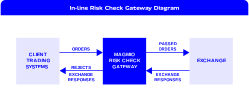
In-line mode mode sits between the exchange and the clients. Every order is checked before forwarding, and any offending orders are dropped before they reach the exchange.
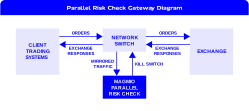
Parallel mode adds no latency to the primary order path, but introduces a delay before a corrective action is taken (e.g., disabling the switch port or updating the exchange limits).
Pre-Trade Risk Check Gateway Overview
The Pre-Trade Risk Check Gateway is a hardware-accelerated market access and risk control engine that validates order flow before orders reach the exchange. Implemented entirely on an FPGA, it enforces deterministic pre-trade risk checks and compliance algorithms at wire speed, independent of server-based software stacks. By combining real-time market data processing with ultra-low-latency order flow inspection, the gateway enables firms to implement robust risk management without compromising trading performance. It is designed for seamless integration into existing trading infrastructure, supporting high message rates, exchange-native protocols, and modern electronic trading architectures.
What do you receive?
Ultra-Low Latency Risk Enforcement
Pre-trade risk and compliance checks are executed directly in FPGA hardware, achieving latencies as low as 200 nanoseconds without impacting market access.
Exchange-Native Market Access
Full support of exchange-native protocols enables transparent order flow and deterministic behavior, with no changes required on the client side.
Audit-Ready Data Capture
All orders and events are captured with nanosecond timestamps, forwarded to the host, and logged, ensuring full traceability for compliance, audits, and post-trade analysis.
Flexible Deployment Modes
Choose between in-line mode for immediate order blocking or parallel mode for zero-latency monitoring with delayed corrective actions.
Supported Exchanges









Partners